
We opened the Kinetic Blocks beta on 1 September. The week that followed brought roughly twenty inbound leads and a considerably clearer picture of this market than we had going in.
Rather than write about milestones, we want to set out what the market told us, including the parts that were uncomfortable.
Industry wants to sell data from its own lines
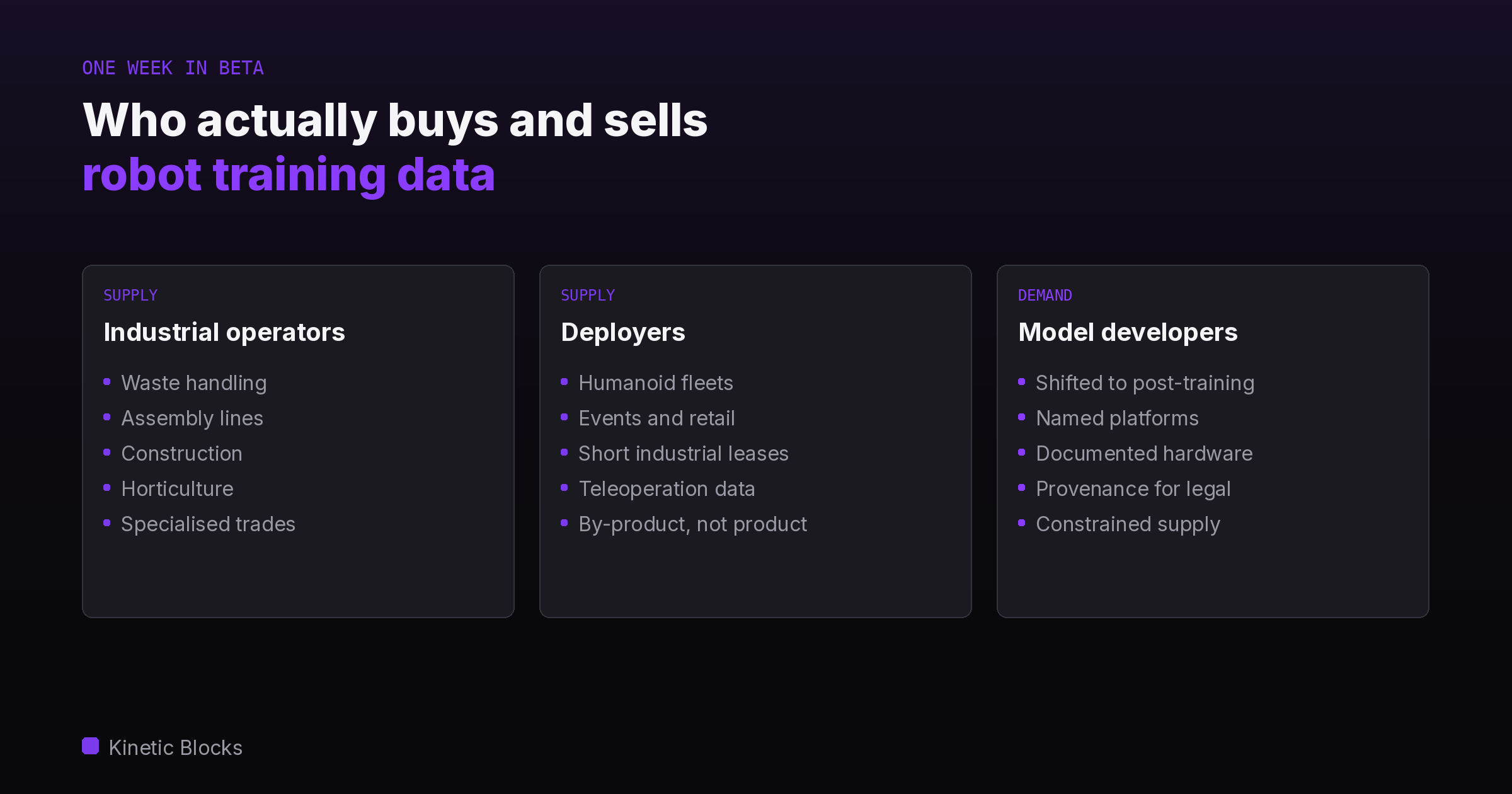
The most consistent surprise has been how many industrial operators approached us as sellers rather than as buyers. Waste handling, circuit board assembly, construction, greenhouse horticulture and beauty services all arrived with a version of the same reasoning. Their sites are already instrumented or straightforward to instrument. The work performed there is repetitive, physically specific and almost absent from public datasets. And the recordings that could be produced belong to them, rather than to a vendor or a customer.
These operators read the value of their own environments more accurately than we expected. What they lack is not awareness but a route to market, which is precisely the gap a marketplace exists to close.
The caveat we are holding onto: interest at this stage costs the interested party nothing.
A new supply segment: the deployers
The second finding is a segment we had not modelled before launch.
A class of integrators and deployers is buying humanoid robots from the large hardware manufacturers and putting them to work on behalf of others, at events, in retail settings and increasingly on industrial sites under short leases. Because these companies operate the fleet rather than build the foundation model, the execution and teleoperation data those robots generate sits with them.
They have proved considerably more willing to license it onward than the foundation labs are. The labs treat exclusive control of their data as part of what they sell to their own investors. The deployers do not.
We now treat deployers as a distinct supply category with its own commercial logic. The data is a by-product of an existing service business rather than the product itself, which makes the licensing conversation easier and the volumes more predictable than with one-off capture projects.
The large model developers have become buyers
Several of the largest model developers have moved the centre of gravity of their work from pre-training to post-training. That turns them from accumulators of data into purchasers of it.
Their requests are specific in a way that egocentric requests are not. Data recorded on named arms and named humanoid platforms, with the hardware configuration and the task taxonomy documented, and with provenance that survives legal review.
The demand for embodiment-captured data is real, and it is constrained. Robot data costs more per hour than human video and arrives in far smaller quantities, because every hour requires a robot, an operator and a capture rig. The large inventories we heard about earlier in the year frequently turn out to be encumbered by customer contracts that assign sole ownership to the party that commissioned the work.
Egocentric data is not finished, but the bar has moved
Two positions are visible in the market at the moment.
One holds that scaling behaviour continues to apply, so additional hours of human video keep producing better models and volume retains its value. The other holds that general purpose robot models will generalise from comparatively little, so exhaustive pre-training coverage matters less each quarter.
Both positions agree on the practical point that matters to a marketplace: ordinary footage from ordinary environments has been commoditised.
The egocentric data that still commands a price comes from places that are difficult to enter, hazardous, regulated or otherwise closed. And it has to pass quality scoring rather than merely exist. Offshore installations, sterile production, heavy industry and specialised trades are where we are directing our own sourcing effort.
What makes a buyer a real buyer
Interest is not demand. Across twenty conversations, the ones that could actually move required three things to be true at once.
Someone in the room with the authority to decide. A budget line in the current period rather than the next one. And an active need, rather than general curiosity about what a marketplace might offer.
Plenty of conversations had one or two. Fewer had all three.
We still believe there is a strong case for driving a wedge into what is currently a one-to-one transaction between labs and collectors. But the bottleneck is not supply, and it is not interest. It is finding the buyers for whom all three are true at the same time.
What we are looking for
Two things in particular.
Industrial operators with repetitive physical work on site who want their environments assessed for licensing value.
Deployers with robot fleets already in the field.
Both can reach us at kineticblocks.com.