
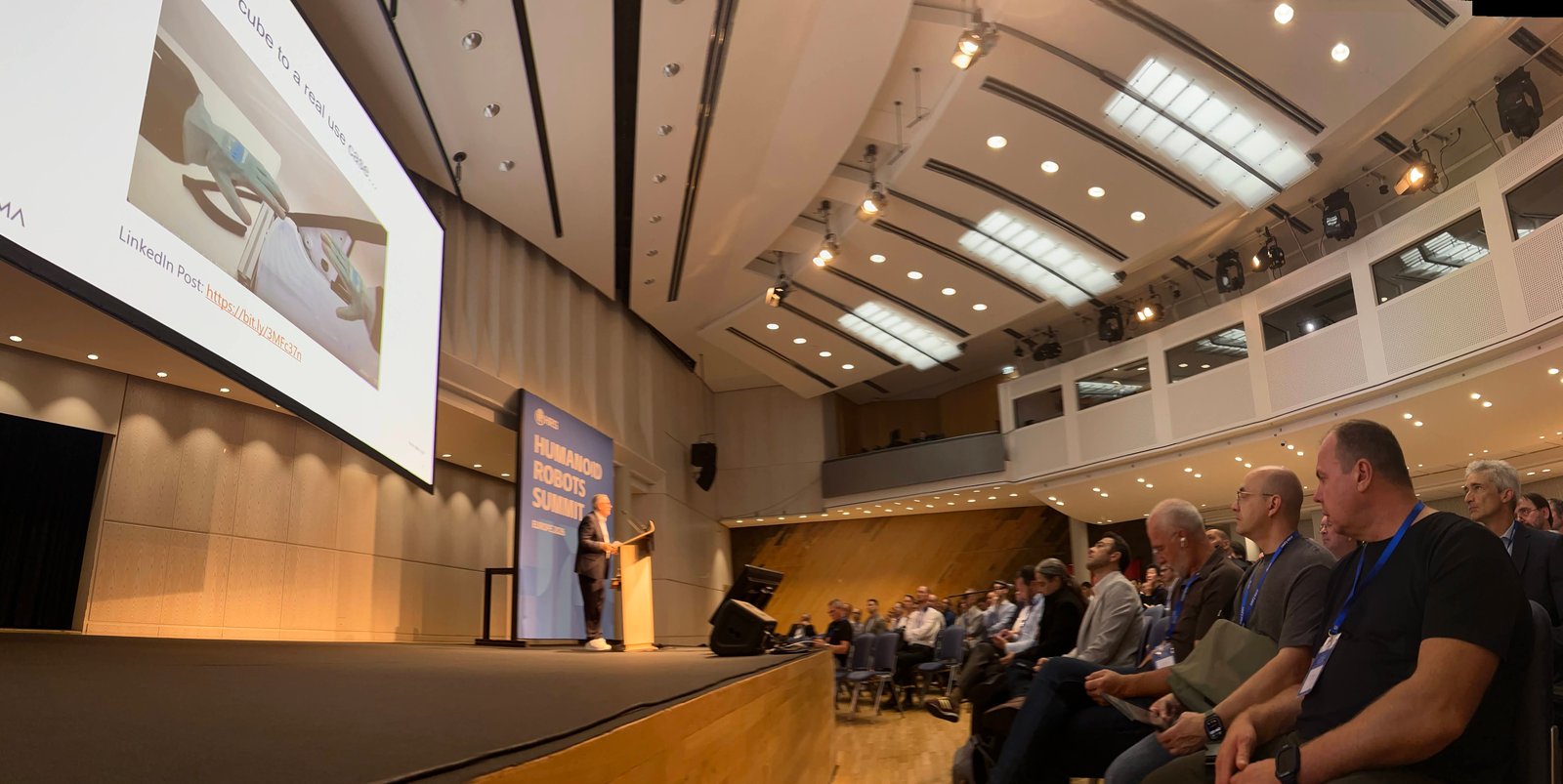
Kinetic Blocks at the Humanoid Robots Summit, Stuttgart, day two
Where day one belonged to the companies putting machines on factory floors, day two belonged to the companies building what goes inside them. The programme moved from deployment economics into actuator safety, fingertip sensing, controller architecture and the data pipelines that turn any of it into behaviour. The panel debate was the only one of the event and produced the sharpest exchange of the two days.
The panel: the factory is not the constraint, the model is
Lyn Wang of Unitree, Jannes Moehlenkamp of P3, Yvan Bourqui of Johnson Electric and Muhammad Saeed of Arena 2036 were asked what stands between humanoids and mass production. Wang answered from the position of the manufacturer with the most units in the field: factory capacity is not the limit, robot intelligence is, since machines that dance convincingly in a proof of concept remain very hard to deploy in a real environment. Her estimate of more than a million units was placed five to ten years out and made conditional on better models rather than on production capability.
Bourqui put the economics plainly, calling it a chicken and egg problem in which volumes are too low to bring cost down while cost is too high to generate the demand that would create volume, with the thousand dollar unit target still far off. His two levers were standardisation, which aggregates volume across customers, and flexible manufacturing, which avoids retooling for small specification changes. His most useful figure was that roughly eighty percent of a product's final cost is determined during the design phase, which is why he argued for collaboration between supplier and integrator before the design is frozen rather than after. On sharing intellectual property he was cautious, describing a field too young and too competitive for voluntary openness, while pointing to telecom as the precedent where proprietary IP eventually became shared through standards that everyone adopted.
Moehlenkamp argued that producibility is the neglected discipline, with the shift from 3D printing to injection moulding and the move from designing for performance to designing for cost. He warned that deep vertical integration becomes a liability at scale, which cuts directly against Unitree's stated model. His point about small and medium manufacturers was the one worth carrying home, since family-owned firms are hit hardest by labour shortage while having the least access to robotics, and P3's answer is to build capability inside the customer's own operations team rather than deliver a system and leave.
Saeed supplied the number that best captures where the technology actually sits, which is that a single humanoid today requires six to seven people spending around three hours a day simply understanding and supervising it. Arena 2036 runs two collaboration formats against that: speedboat projects taking one defined problem to a deployable proof of concept in six months, and platform projects where four or five large companies work with research institutes across several challenges at once. He also placed academia's obligation precisely, which is to carry solutions from TRL 6 to TRL 7 through 9 alongside industry rather than stopping at publication.
Two exchanges from the floor deserve recording. A question on functional safety pointed out that verifying an actuator followed its commanded trajectory proves nothing if the robot's brain issued the wrong command in the first place, which suggests the safety framework for humanoids needs rethinking at the system level rather than the joint level. And Saeed described an AGV deployment at Marienhospital Stuttgart that surfaced around a thousand practical problems, including elderly patients becoming distressed by autonomous movement, which is the kind of finding that only appears once a machine meets real people.
The panel also named data siloing as a brake on the whole field, with the observation that half a million robots each writing into separate data centres produces no compounding intelligence, and the note that China is already developing national standards for video and training data collection.
Actuator safety is becoming a standard, and the standard is being written now
Ricard Picas of Novanta gave the most technically substantial talk of the day, opening from the fact that the actuator is up to half of a robot's hardware cost and is no longer a commodity, since it serves as both movement provider and perception device reporting position, force, torque and acceleration. His architectural argument favoured distributed functional safety over centralised, because reusing the same sensors for control and safety removes the latency that forces a large separation distance between human and machine.
The evolution he described runs from uncontrolled stops, where safe torque off cuts power and the robot falls so the cell must be caged, through today's controlled stops and actively damped falls, where regenerative braking is configurable per joint and the direction of a fall can be detected and managed, toward a future state where the machine does not fall at all because torque is maintained through failure and stability is measured by IMUs inside the actuators themselves. Loss of communication triggers a pre-programmed dynamic response rather than a collapse, and safe trajectory monitoring supervises complex paths rather than velocity and position alone.
The regulatory point matters more than the product detail. A draft product standard covering dynamically stable industrial mobile robots is in development on a three year project that began in July 2025 and releases in mid-2028, intended to be harmonised across the EU and the US and therefore legally binding. The working group is open in the sense that any country may appoint experts. Norway should have people in that room.
Fingertips, which is where three companies are converging
Mo Maghsoudnia of UltraSense Systems presented the most differentiated sensing approach we saw across both days, using time of flight pulse echo ultrasound inside the fingertip to infer localised deformation at five hundred micron resolution, which matches human fingertip sensitivity, and producing a two dimensional force map rather than the single scalar that camera vision and motor current give you today. The capability nothing else offers is material detection, since reflection amplitude varies with the acoustic impedance of whatever is being touched, so metal, rubber, glass and plastic are distinguishable at contact. Sub-surface lateral displacement gives shear and slip detection, and because the sensing element sits inside the housing the elastomer can wear without degrading electrical performance, which is the failure mode that ends capacitive e-skin after thirty to forty thousand touches.
Andreas Friedrich of Allegro MicroSystems approached the same body from automotive semiconductors, and his pain point list matched what deployers reported the day before, with shoulder joints overheating and forcing reduced lift capacity, torque ripple producing jerky motion, and acoustic noise mattering more than expected in shared factory space. His engineering answer to the thermal problem is architectural, since moving from 12V to 48V reduces thermal losses by a factor of sixteen because loss scales with the square of current. His sensing portfolio spans inductive position sensing for large joints at a tenth of a degree, TMR for small joints in two by two millimetre packages, and a quantum tunnelling tactile film claiming up to fifty-five times the sensitivity of strain gauges.
Michael Mross of HARTING showed molded interconnect devices, where a laser activates an additive inside a plastic part and conductive traces are then plated onto the activated surface, which allows circuits, sensors, heating and heat dissipation to be integrated into the structural part itself. The demonstrator was a fingertip with embedded electronics, and his honest caveat was that assembly time remains high at this component density.
Bosch on the difference between 95 and 99
Jan Schneider-Kraus, Head of Engineering at Robert Bosch Robotics, set the internal KPI for factory automation at a task success rate of 99 point something percent and was direct that ninety-five percent is already hard while 99.x is a different problem entirely, which puts the eighty-five percent that Arcelik-LG reported from its rubber part station the previous day into proportion. He considered locomotion largely solved for factory settings, with moving bases sufficient for most plant environments, and named manipulation as the real bottleneck, which is why Bosch is developing dexterous manipulation jointly with Schunk.
His data pyramid ran from robot operation data as the scarcest and most valuable, through embodied human data from wearables, then simulation, then internet video as the largest and lowest quality corpus, with the stated goal of pushing embodied human data collection into the millions of hours. His warning about egocentric video is one we should repeat to buyers, which is that inferring pose, force and tactility from video is a stochastic approximation that introduces systematic error, so the modalities have to be captured directly and synchronised in time, and quality has to be solved at the source rather than repaired downstream. He also said, without elaboration, that whoever owns the data controls it.
Exxeta on data quality as a discipline
Julian Kramer of Exxeta gave the talk closest to our own operating model, laying out a five level data pyramid trading cost against scale: teleoperation on a real robot capturing all joint and gripper states at the highest cost, handheld UMI grippers that lose joint states, motion capture suits that scale without a robot but lose gripper state, simulation that preserves data structure while losing real physics, and general image and language data at the base. The constraint is that some real embodiment data is always required regardless of what else is available.
His quality argument is the one the market has not internalised: a hundred high quality episodes beat a thousand containing ten bad ones, idle ratio should be trimmed or at minimum flagged, and around one percent failure episodes should be deliberately included and labelled with recovery sub-tasks because the models learn to recover from them. His pipeline runs collection, quality control, curation into versioned and traceable datasets, fine-tuning, task-specific post-training, then deployment, which is precisely the sequence we built KBQS and chain of custody documentation to serve.
He also named what he called the data dilemma, that manufacturing vision data is intellectual property and European companies will not put it on non-EU servers, and Exxeta's answer is a sovereign on-premise platform covering collection, curation, training and fleet deployment. That is the same problem we address from the opposite direction, since a company that will not export its data can still license it under terms that keep control, and the two approaches are complementary rather than competing.
Swisslog on building the layer before the robots arrive
Jan Andreas Daske of Swisslog, part of the KUKA group, argued that industrial automation fails for three recurring reasons: master data that does not hold, variety that breaks the flow, and a bottleneck that turns out to sit somewhere other than where automation was applied. The underlying absence is a common operating system, with SAP, WMS and MES creating islands while Excel remains the largest ERP in the world and is neither trackable nor trainable.
His argument for humanoids is the strongest form of the case we heard all week, which is that the human form is the first automation that does not require the environment to be rebuilt around it, so it opens the entire installed base rather than only new construction. What it does not solve is judgment, since knowing when a task is finished or how to handle a damaged part is unwritten shop floor knowledge that has to be captured and formalised. His sequencing was unified semantics first, then unified actions, then unified data, all before hardware, on the grounds that integration timelines of six to twelve months now run slower than the AI evolves, so a system specified today is outdated at go-live. The live reference is an Ohio automotive plant running since July with two hundred and eighty-five robots bolting a body shell every two seconds, where the hard part was legacy systems, semantics and exception paths rather than robotics.
The Chinese supply side, and what it is now selling
Zhang Min of Unitree presented the breadth that has become the company's argument, with the R1 humanoid now at four thousand nine hundred dollars against roughly twelve thousand for H1 in 2023, ninety-five percent of components developed in house, a new product generation every twelve to eighteen months, and more than a hundred robots working daily in their own factory assembling G1 units.
The part relevant to us is that Unitree is now presenting itself as a data company as well, with a six thousand square metre proof of concept facility running material sorting, box handling, domestic and rehabilitation environments for collection and training, open-source whole-body datasets covering supermarket, home and office, and the claim that factories generate an average of two thousand terabytes per month, described from the stage as the critical raw material for physical AI. Their compute trajectory runs from around two hundred and fifty TOPS today to a target of two thousand by 2028.
Rokae presented from the controller side, positioning itself as a Tier 1 supplier to humanoid OEMs in the way Bosch and ZF supply automakers, with a controller platform running industrial arms, cobots and humanoid arms in one programming environment, a new embodied AI controller handling up to twenty axes with whole body control so that AI teams can work on models rather than motion, and the observation that force control allows a task such as USB insertion to be learned in around a hundred cycles.
Alongside them Krzysztof of Nucleus Robotics, a four month old Munich company, described a business model of selling labour by the hour rather than hardware, one to two months of simulation preparation before going straight onto the factory floor, and an autonomy split today of roughly fifty-five percent teleoperation, twenty-five percent human in the loop prompting and twenty percent autonomous. They moved from bipedal to wheeled platforms quickly because bipedal certification is currently close to impossible, and they are targeting twenty-five robots deployed by the end of the first quarter of 2027.
Two sessions that did not fit the pattern
William Dalton of VicOne made the security case: robotics is a more attractive target than IT because compromise produces physical harm rather than financial loss, frontier models have moved CVE exploitation success rates from around fifty-five percent six months ago to near total today, and a threat actor can run a frontier model on premise for roughly eighty thousand dollars. His structural point is that manufacturers ship general purpose firmware into deployments that each need their own security profile defined by expected behaviour, which is the same per-deployment logic Porsche Engineering applied to safety the day before.
The care sector session made the demand-side argument that eighty-five percent of home care recipients in Germany are nursed by relatives, so relatives are the buyer, and that the barriers are acceptance, privacy concern, missing wifi in nursing homes and above all the absence of any model for allocating ongoing cost once a pilot ends. The funding options proposed were rental rather than purchase, reimbursement tied to demonstrated outcomes, and cost split across insurers, authorities and providers.
What we take from day two
Three companies with no commercial relationship to each other, Bosch, Exxeta and Swisslog, independently identified data ownership as the intellectual property question that decides whether a deployment happens, and each has responded by building or buying a way to keep control inside the customer's environment. That is the market forming around the problem we exist to solve, and it tells us the objection we will meet is not that data has no value but that its value is too obvious to release without terms.
Exxeta's quality argument, that a hundred clean episodes beat a thousand containing ten bad ones and that failure episodes must be labelled rather than discarded, is a direct external validation of scoring datasets before listing them, and Bosch's insistence on solving quality at the source is the same argument aimed one step upstream. Versioned and traceable curation appeared in Exxeta's pipeline as a named stage, which is the first time we have seen provenance treated as infrastructure rather than as paperwork by anyone other than ourselves.
What we are doing
Kinetic Blocks opened in beta on 1 September 2026 with twelve data vendors under MoU, covering egocentric human video, teleoperation recordings, and robot execution and action data. Every dataset is scored through KBQS before listing, and delivery is in LeRobot v3.0 format with chain of custody documentation attached. We are an NVIDIA Inception member.
If you record human or robot data on an industrial site and hold unused commercial rights, or if you are buying data and cannot establish where it came from, that is the conversation we came to Stuttgart for.
Lars-Fredrik Forberg, CEO lars-fredrik@kineticblocks.com