
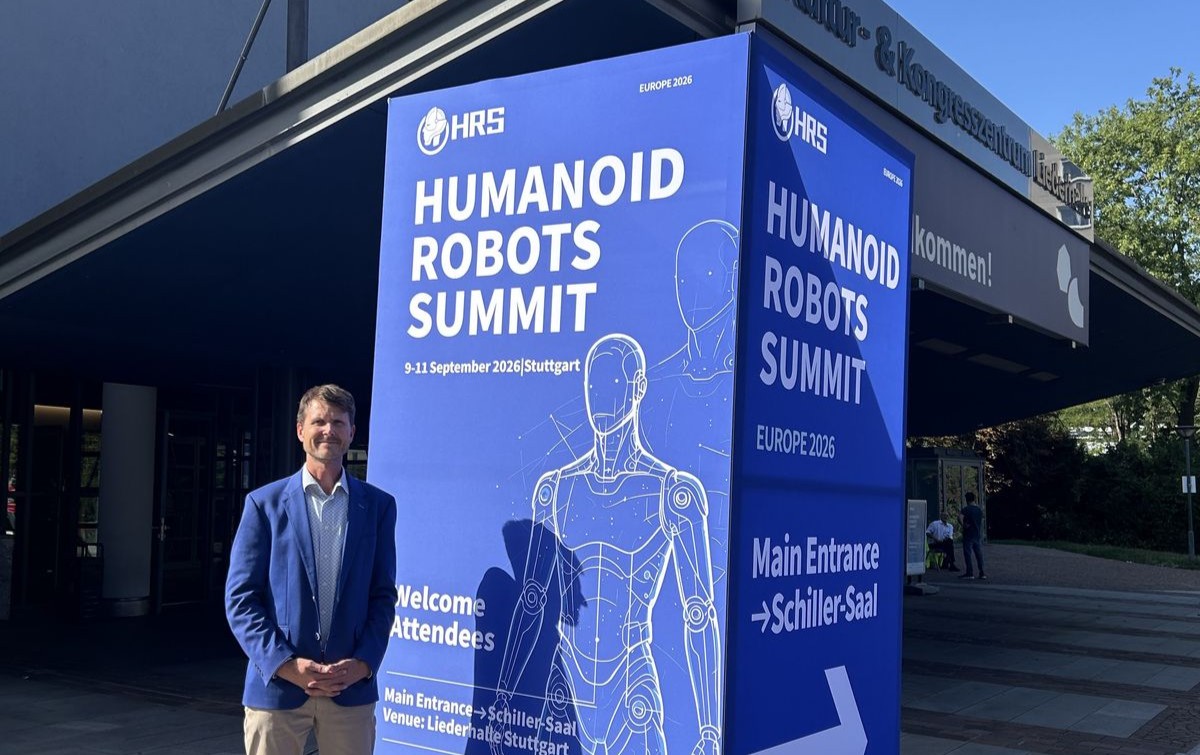
Kinetic Blocks at the Humanoid Robots Summit, Stuttgart, day one
The Humanoid Robots Summit is smaller than the coverage of the sector would suggest, with five hundred attendees, a sold-out hall for the second year running, and a modest exhibition floor. The value sat almost entirely in the industrial keynotes, where the companies actually putting machines on factory floors explained what deployment requires and where it stops. The useful thing about that programme is that five separate speakers arrived at the same bottleneck from five different starting points.
Siemens on the four things that separate a pilot from production
André Scholz, Head of Innovation for the Autonomous Factory at Siemens, gave the most complete account of the gap, using Siemens' own plants in Erlangen and Nanjing as customer zero and demonstrating a wheeled robot destacking tote towers onto a conveyor. He named four blocks.
Safety and integration, where the spectrum runs from caged through collaborative to fenceless and the value only arrives at the fenceless end, which requires human intent prediction and redundant safeguards that do not yet exist in certified form.
Sustained uptime, where most prototypes run two to four hours against an industrial requirement of eight to twelve hour shifts run two or three in a row, with battery capacity and charging time as the binding constraint.
Dexterity, where the human hand has twenty-seven degrees of freedom and most robotic hands fall far enough short to be limited to simple pick and place, and where the hard cases are flexible and soft objects such as cables, plastic bags and folded garments.
Cost, where the target is a fall from roughly two hundred and fifty thousand euro per prototype to thirty thousand per unit, against a supply chain in which actuators account for sixty-two percent of cost, mechanical structure thirteen, perception and compute twelve, and power and wiring thirteen.
His filter for whether a humanoid is the right form factor deserves repeating in full, since it disqualifies most of what gets demonstrated. The task must be economically important and measurably repeatable. The environment must be structured enough to be predictable. Mobility must genuinely be required, or a fixed robot is better. And legs must genuinely be required, or a wheeled base with one to three arms is better.
His vendor criteria were equally concrete: ninety-five percent uptime as the threshold for a two to three year payback, open APIs across REST, ROS2 and OPC UA, ISO 10218 certification, local European support and spare parts, and task-specific end effectors.
Arçelik-LG on what two proofs of concept actually produced
Ercan Gündüz, Head of Production Engineering and Automation at Arçelik-LG, gave the most honest set of numbers of the day, opening from the position of Europe's largest air conditioning producer running at sixty percent automation against comparable Chinese operations running three times that, and stating plainly that humanoids are not the objective and competitive manufacturing is.
The first proof of concept picked rubber parts and placed them on carton. It took around four months to prove out, reached an eighty-five percent task success rate against a twelve second station cycle, required no human intervention, and ran thirty minutes at its longest before overheating stopped it. He was direct about what overheating means commercially, which is that manufacturers want the cheap cooling solution and the robot has to earn anything more expensive, and that a shoulder failure puts costly hand components at risk.
The second proof of concept ran an SAP EWM instruction into physical material flow, with the robot walking ten metres, aligning and pushing a ten kilogram cart into position and reporting status, on a fifteen minute cycle that permits charging across two shifts, against a fifty metre target distance.
His conclusion was to simplify locomotion and keep human-like manipulation, since factory floors are flat, routes are predictable and space is controlled, so a wheeled base with a vertical lift removes variables that legs introduce for no gain. He framed AI performance as a system property, arguing that no model compensates for unstable hardware or absent recovery, and listed five requirements: reliable grasp, stable perception, thermal stability, computing headroom and autonomous recovery. The strategic point was the last one, that a factory should configure tasks rather than develop a new model per task, which is why LG is building GXL as a robot-agnostic factory layer.
Renault and Wandercraft on six months per skill
Laurent Duthoit of Renault and Camille Croze of Wandercraft put the sharpest number of the day on the training problem, which is that teaching a humanoid one industrial operation currently takes six months, running from teleoperation capture through world model construction into simulation, against an automotive requirement of days or weeks.
Their explanation matters more than the number. Industrial data is scarce, and most of what exists was recorded in consumer and home settings, so the recordings that would compress those six months sit on operating production lines rather than in any public corpus.
The deployment behind it is not speculative, with a first Calvin prototype built in forty days on an exoskeleton chassis, a V1 co-developed with Renault revealed at the summit, and three hundred and fifty units planned into Renault plants before the end of 2027. The cases are tyre handling at Douai, where an operator lifts four tyres a minute at thirteen to fifteen kilograms each and the robot takes two at a time, box depalletising at twenty to twenty-five kilograms, and kitting in the body shop, which remains unsolved because dexterous hands trialled on metal parts broke within days.
They confirmed the same thermal ceiling Arçelik-LG hit, with motors overheating after two to three hours of heavy lifting and neither active cooling nor the ice packs used by Chinese competition teams ready for production, and described today's safety answer as a laser-scanned perimeter that freezes the machine when a person enters, with heartbeat detection as the research direction.
Porsche Engineering on the safety case, which is the missing discipline
Hagen Stübing and Ehsan Sharafian Ardakani of Porsche Engineering transferred the automated driving methodology directly onto humanoids, and the transfer is convincing because the algorithms came from robotics in the first place and return enriched by years of safety-critical process.
Their three pillars are safety by design, meaning analysis and requirements derived upfront rather than added later; functional evidence through deterministic testing against specification; and statistical evidence through operational validation in the real world, which for vehicles is mileage and for humanoids is working hours in real environments, since that is the only way unknown unknowns surface.
Worked through a reception clerk use case, the method runs from use case definition through hazard and risk assessment, into explicit testable safety goals, a safety concept, safety requirements with numbers attached such as sensor range and reaction time, FMEA and FTA analysis, and a safety evidence package compiled before deployment. Their central design problem is the safety monitor, which supervises continuously for violations and must be tuned between conservative settings that destroy availability and permissive settings that allow drift into states the machine cannot recover from. Their conclusion was that safety is always use case specific, so a new task or a new environment requires a new safety case, and that testing alone never suffices.
Every integrator deploying humanoids will need a framework of this kind, and almost none of them have one. The point we would add is that a safety case built on operational hours depends entirely on knowing where those hours were recorded, under what conditions and with what rights attached, which is a provenance problem before it is a safety problem.
Boston Dynamics on what a useful robot consists of, and on data
Aya Durbin, Humanoid Director of Product at Boston Dynamics, divided the machine into hardware, an AI brain and application software for operations teams, and argued that the third decides adoption, since operations staff who do not trust the robot will not run it.
The latest Atlas carries fifty kilograms with thirty kilograms of continuous lift, runs around the clock on two self-swappable batteries, and is built so any limb can be replaced in under five minutes. Training runs by three routes: behaviour cloning, where an operator avatars the robot through VR and five to ten hours of examples yields an autonomous policy; simulation across millions of varied runs; and egocentric video, where a person wears a head camera and gloves, which she called the most accessible route and one available in any facility today. The reasoning layer is prompted rather than coded as behaviour trees, and the Hyundai proof of concept ran teleoperation, then on-site training, then autonomy, with the insistence that this is a general-purpose robot applied to a sequencing task rather than a sequencing robot.
Asked directly about the data market, she said annotation stays proprietary because the team can instruct its own annotators and a supplier relationship does not reproduce that loop, that raw data holds no commercial interest for them at present, that their foundation model work runs with Google DeepMind, that a marketplace may have a role later, and that whether data can be resold at all is an open question for her.
We would rather report that plainly than dress it up, since a company with its own capture pipeline and its own annotators is the buyer with the least reason to buy, and the unresolved resale question is the more consequential half of the answer.
AgiBot on scale, and on the bottleneck being data rather than hardware
Simi Wang, VP Europe at AgiBot, reported fifteen thousand units shipped cumulatively by August 2026 after two and a half years in market, all deployed rather than warehoused, CE certified for Europe, with the customer owning the data they collect.
The part relevant to us is the Maniformer division launched in April, built on the thesis that the bottleneck is data rather than hardware and that robots move slowly because training data is insufficient. Their stated holdings are over two million hours of robot data and eight million hours of human-centric data across more than five thousand scenarios in supermarkets, logistics and factories, robot-agnostic and fine-tuned per unit, alongside MeGo gripper and view hardware sold so customers can capture their own. They noted that Alibaba operates the largest data factory globally and that AgiBot sources through that partnership, that data may be proprietary, purchasable or open source, and that data collected in the United States may not be usable in Europe.
FMC3 on why pilot data does not survive contact with production
Joachim Fetzer of FMC3 Robotics, previously at Bosch, gave the clearest formulation of the problem we exist to solve, naming three gaps between a pilot and production.
The coverage gap, where pilot data misses operating variability, robustness and edge cases across different products, materials and contexts. The context gap, where raw sensor data is insufficient because machine states, process steps, material conditions and operator interactions must be captured alongside it. The adaptation gap, where machine wear, tooling changes and process optimisation give any training set a limited shelf life.
His principles follow from that: start from production reality rather than a demo environment because every site differs, keep data in a closed loop driven by real production, and maintain physical relevance because world models fail without physical data.
The adaptation gap is the one the industry has not priced. A dataset with a shelf life is a subscription rather than a purchase, which changes both what a supplier is worth and what a buyer needs to contract for.
The capture layer, where the money currently is
Three vendors presented on capture and all three described the same missing piece.
Dennis Kloppenburg of Xsens argued that video alone fails the moment hands leave frame while inertial capture always sees the movement but needs video for accuracy, so fusion across up to six modalities into one common schema covering pose, forces and vision is the only route to usable fidelity, with Meta's Project Nymeria and its three hundred hours of paired video and motion capture as the reference. He also flagged the format question as live, with BVH in use, NVIDIA MCAP emerging, SMPL widely adopted, and a February 2026 mandate from China's MIIT requiring one common file format across all companies, which is the first case of a government legislating the interoperability layer rather than waiting for it.
Maarten Witteveen of MANUS argued that kinematics is solved and tactile sensing is not, and that the goal is to remove the teleoperation layer entirely because trained pilots are expensive while the people with the domain knowledge are nurses and mechanics. He named four things that must be captured at the fingertip: grip force, friction and slip onset, compliance, and internal contact distribution. He was direct that today's tools leave what he called scars in datasets, since narrow one-to-one interfaces generalise to a single hand and a single grip while external thimble rigs force the operator to move unnaturally.
Dong Zhang of DAIMON Robotics made the same argument from the sensor side, distinguishing demonstration, where a robot succeeds once, from manipulation, where it succeeds repeatedly across changing tasks and deforming objects, and presenting vision-based tactile sensors covering twelve dimensions at 128 Hz with five million cycles of durability, alongside a newly launched omni-modal dataset and a tactile world model.
The European position
Francesco Ferro of PAL Robotics, founded in Barcelona in 2004 and financed without venture capital, made the case that European robotics predates this cycle, with more than two hundred StockBot units running RFID inventory day and night across fifteen countries for customers including Decathlon and Inditex. He was blunt that wheels serve most current use cases better than legs, which is now the third speaker to say so, expects mass adoption by 2030 rather than 2040, and closed on the point that the market does not care about the robot and cares only about the use case, with ROI on simple tasks still hard to justify even with public funding.
Werner Kraus of Fraunhofer IPA provided the independent measurement, with a sixty-six test framework covering capability, functional safety, cybersecurity, energy efficiency and cleanliness, run across Unitree G1, Dobot Atom, Agibot G2 and Neura machines. Collision force testing against ISO norms puts almost every result in the yellow to red range, the fifty kilogram Unitree G1 is not permitted for power and force limited operation under EU norms, and their own EU-funded work needs two hundred and forty trials, about four hours of teleoperation, to train one cable-handling task. He also reported from fourteen company visits in China that Leaderdrive supplies harmonic drives to sixty to seventy percent of all humanoid manufacturers, and that behind a hundred and fifty to two hundred brands sits a far smaller number of actual OEMs.
Patrick Schwarzkopf of VDMA framed the day around the shift from deterministic to intent-based automation and asked the audience to stop debating legs, while Accenture supplied the market numbers, with nineteen thousand humanoids deployed in the first half of 2026 against a sixty thousand full-year forecast, ninety-seven percent sourced from China, and a placement on the hype cycle between the peak of inflated expectations and the trough of disillusionment. We report those figures as presented and have not verified them independently.
What we take from day one
The training cost was quantified from the stage five times: four hours of teleoperation for one cable-handling task, five to ten hours of behaviour cloning for a policy, four months to prove out one pick and place station at Arçelik-LG, six months for one industrial operation at Renault, and two million robot hours held by a single Chinese manufacturer. Every industrial speaker described the constraint as a scarcity of the right data rather than a shortage of data in general.
Fetzer's three gaps explain why, since production data must cover variability, carry context about machine state and process step, and be refreshed as the line changes, which describes a continuous supply relationship rather than a one-off file transfer.
What nobody addressed is the licence that data travels under, whether it can be sold, and how a buyer establishes where a recording came from. Asked from the floor what Europe should do given the announced Chinese data collection programme and Renault's own fleet, Dennis Kloppenburg went straight to ownership, saying the question is not who collects the data but who holds it afterwards, whether the state, an OEM such as Volkswagen, or a US platform company, and that European manufacturing knowledge should stay on European soil.
That is our layer stated in policy language, and it was the only time in the day anyone put it on the record.
What we are doing
Kinetic Blocks opened in beta on 1 September 2026 with twelve data vendors under MoU, covering egocentric human video, teleoperation recordings, and robot execution and action data. Every dataset is scored through KBQS before listing, and delivery is in LeRobot v3.0 format with chain of custody documentation attached. We are an NVIDIA Inception member.
We are in Stuttgart for the rest of the week. If you record human or robot data on an industrial site and hold unused commercial rights, or if you are buying data and cannot establish where it came from, that is the conversation we came for.
Lars-Fredrik Forberg, CEO lars-fredrik@kineticblocks.com