

Kinetic Blocks opened its marketplace for commercially licensed, provenance-tracked robot training data in beta on 1 September. The first month has shown us more about how this market works than the planning we did before launch.
Supply is running well ahead of demand
Roughly nine out of ten organisations registering on the platform are sellers, and buyers make up the remaining tenth. The sellers range from capture teams recording egocentric video in factories, warehouses and construction sites to teleoperation operators and robot integrators who collect data as a by-product of deployment. We read this as a sign that the capacity to produce data is being built faster than the purchasing processes at the companies training robot policies. Our priority for the coming months is therefore to bring more buyers onto the platform, so that sellers have requests to compete for.
Data transactions are still largely a manual business
Sellers and buyers find each other, exchange samples and negotiate terms directly over email and Teams, and a marketplace only earns its place in that exchange if it makes it safer and faster for both parties. This is why we are building the platform around trust. Buyers need to trust that a dataset is good enough before they commit budget, which is the purpose of our quality scoring and chain-of-custody documentation. Sellers need to trust that they will be paid for data that cannot be returned once it has been delivered. In China, where suppliers commonly take payment in advance, we will work to establish the same platform-held payment terms as elsewhere, knowing that this will take longer than in other markets. The people we have met on both sides of the market have generally been eager to get started and competent at what they do, and that has made the manual work of the first month easier to carry.
A new category: interests
Our first product change based on these lessons is a new category we call interests. A formal data request asks a buyer to specify environments, tasks, hardware, formats and volumes before anything happens, and many buyers cannot commit to that at an early stage of a project. An interest lets a buyer describe in a few lines what kind of data they are looking for. We then match it against what sellers already hold or can collect and bring the two parties together, and the buyer can write a formal request later, once the requirements are clear enough.
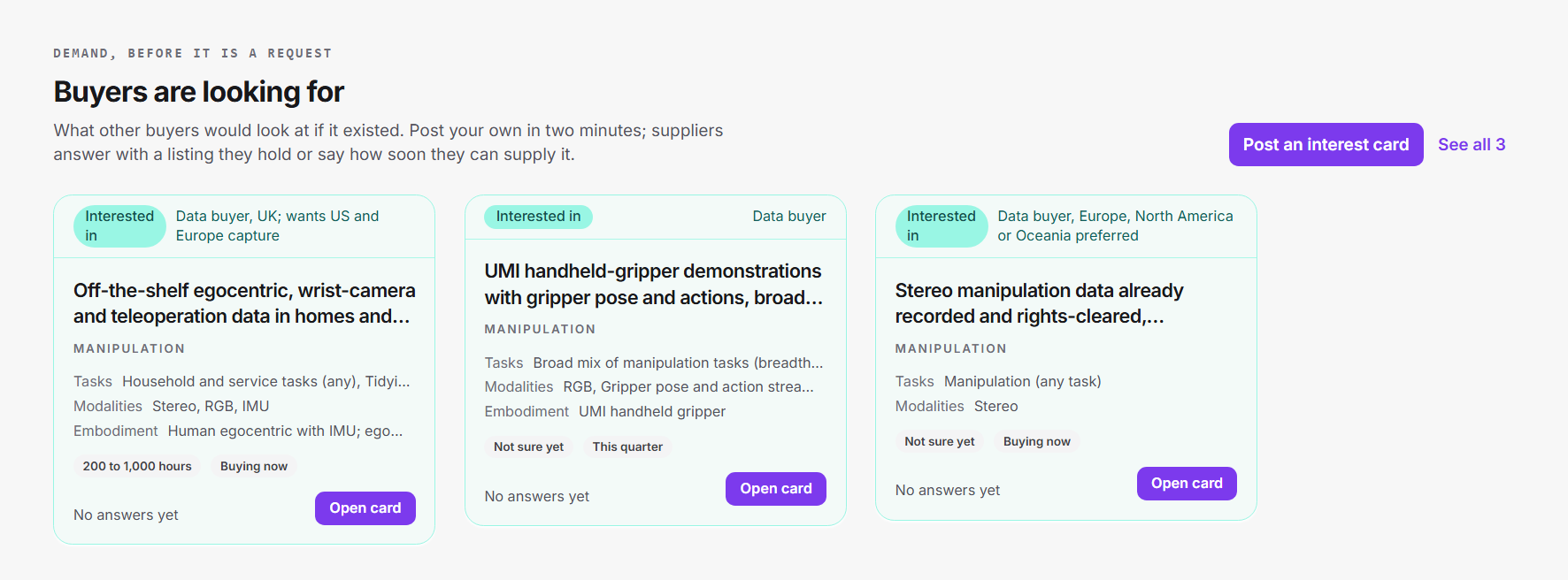
The first interest cards on the platform. Each one is a buyer saying what they would look at if it existed; suppliers answer with a listing they hold or say how soon they can supply it.
What we do not yet know
We also want to be open about what we do not yet know. Our quality scoring tells a buyer how a dataset performs on capture and documentation quality. Whether the data is good enough to train a working robot policy is still an open question for us, as it is for the rest of the market, so we are operating with blinders on until that link can be measured. We therefore support the work others in the field are doing to benchmark training data against policy performance, and we are planning a benchmark of our own that will connect our scoring to outcomes in robot training.
Meet us in San Francisco
We will be in San Francisco for Tech Week from 5 to 11 October, and we would like to meet four groups there: buyers training robot policies, sellers and collection teams with data to list, integrators who hold deployment data without a way to monetise it, and investors following physical AI. Get in touch through kineticblocks.com so we can find a time during the week.