
Kinetic Blocks has been building quietly since the spring, working with a first group of data suppliers and a small number of early users, and on 1 September the platform opens as a soft launch. The marketplace is in beta, access is granted on request rather than automatically, and we are approving only sellers who hold data they can license and buyers who train models on it.
The reasoning behind the company is that the binding constraint in humanoid robotics has moved away from hardware and model architecture and towards data, and that the teams holding usable data and the teams who need it still find each other through bilateral conversations that take months, produce agreements nobody can compare, and leave the rights position unclear long after the data has entered a training run. Kinetic Blocks exists to turn that exchange into ordinary commerce, where a supplier lists a dataset with documented provenance and a defined commercial licence, and a buyer can evaluate it, pay for it and download it without running a procurement cycle around every transaction.
What a soft launch means here
The catalogue is small and will stay small for a while, several parts of the workflow are still manual behind the scenes, and the KBQS grading criteria will be revised as we see more data. We would rather run a beta with a limited number of serious participants and fix what breaks in front of them than open the doors wide and discover the same problems at scale. Anyone who joins in the first months should expect to be talked to often and to have their feedback change the product.
How it works from 1 September
Sellers and buyers request access at kineticblocks.com, and each request is reviewed individually. We are looking for people on both sides who are real, meaning suppliers who hold or capture data they have the right to license and buyers who are training humanoid models rather than surveying the market, and we will decline requests that do not fit while the platform is in beta. Approved sellers upload datasets covering egocentric human video, teleoperation recordings and robot execution data, with chain of custody documentation, in LeRobot v3.0 or in a format of their own, and they set their own prices, since Kinetic Blocks takes a platform margin and does not intervene in seller pricing or in how sellers position their data. Approved buyers download against payment with the commercial licence attached to the purchase, so the rights position is settled before the data reaches a model. Submissions pass through KBQS, the quality system Kinetic Blocks has built to score datasets consistently rather than leaving each buyer to invent their own acceptance criteria, which is where a large part of the cost of using external data currently sits.
Apply
Sellers and buyers request access and tell us who they are and what they hold or need. We read every request and approve the ones that come from people actually producing or training on this data.
List and score
Sellers upload with chain of custody documentation, set their own prices, and receive a KB Quality grade on the same scale as every other listing.
Buy and license
Approved buyers pay and download, with the commercial licence settling at the same moment as the transfer, so the rights position is clear before the data reaches a training run.
The team
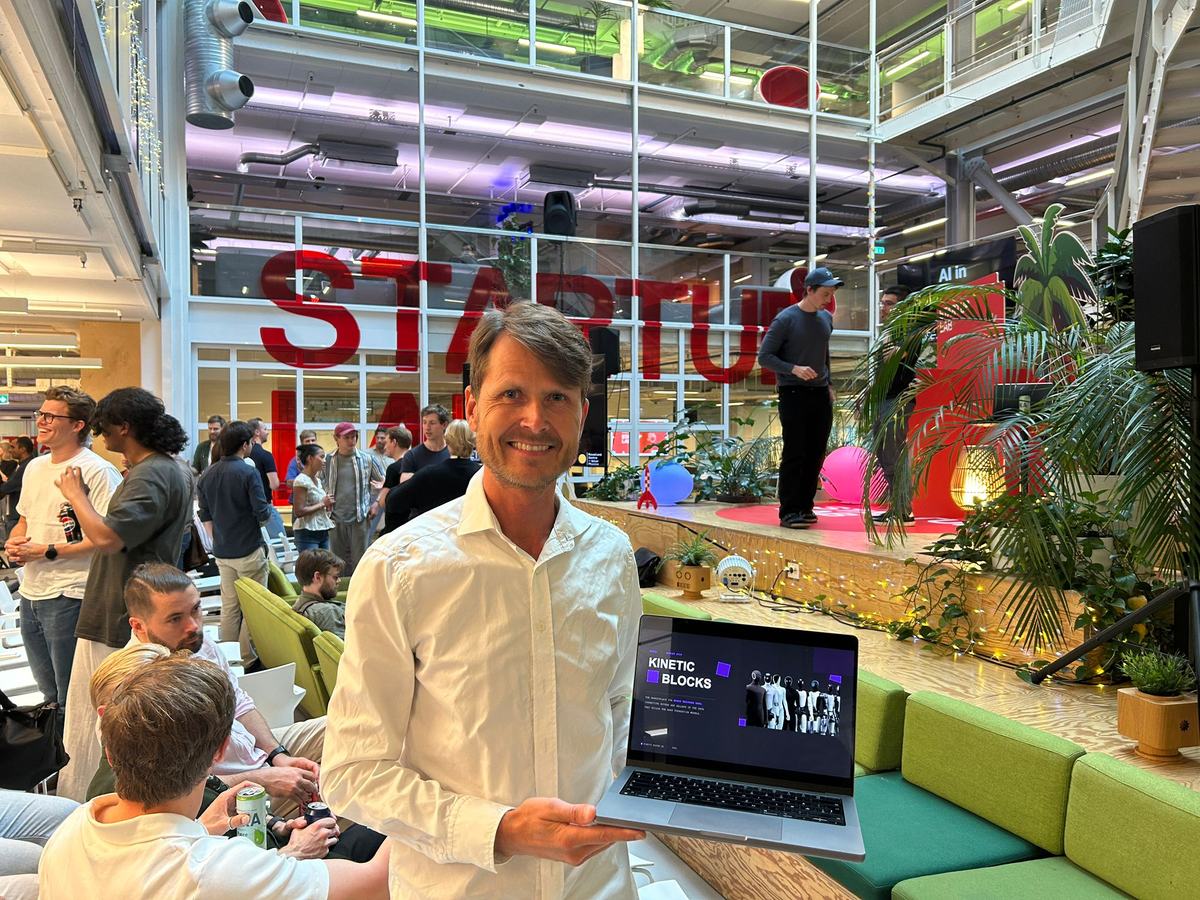
CEO of Kinetic Blocks Lars-Fredrik Forberg welcomes data sellers and buyers onto the new marketplace. He resides at Startuplab, Norway's biggest hub for tech entrepreneurs.
Kinetic Blocks was founded in Oslo by Lars-Fredrik Forberg, who runs the company as CEO, together with Erik Ålgård and Christian Rokseth, both of whom were early investors in 1X Technologies and have followed the humanoid category from well before it became a market. Erik chairs the board and spent ten years on the board of 1X, which gives the company a long view of what humanoid programmes actually need from the people who supply their data, while Christian is also the publisher of Humanoid.guide. Marcus Hølland Eikeland built the platform's first MVP and remains involved as an advisor. Data quality is led by Leo Terry in Boston, who owns the KBQS pipeline.
The team is small and will grow through the autumn, with openings on the engineering side, where the work is ingestion, validation and delivery infrastructure, and on the commercial side, where the work is building supply and demand across the US, Europe and Asia. Kinetic Blocks will also open a seed round in the fourth quarter of 2026, and conversations with investors in the Nordics and elsewhere are already underway. Anyone who wants to build in this category, whether as an employee, a supplier or an investor, is welcome to make contact.
What comes next
The team treats 1 September as the beginning of a beta rather than a finished launch, and expects the first months of real transactions to teach it a good deal about what buyers actually value, how suppliers want to price, and where the friction sits in a category that has not had a marketplace before. As far as we are aware, no one else has opened a two sided marketplace where independent suppliers list, price and sell humanoid training data directly to buyers, and the point of opening now, deliberately small and with a gate on who comes in, is to learn how that market behaves before scaling it. We are eager to meet the people building in this field and to learn from the first customers we serve.
Request beta access at kineticblocks.com
Requests are reviewed individually. Tell us whether you are selling or buying, and what data you hold or need.
Kinetic Blocks AS, Oslo.
Christian Rokseth is a co-founder of Kinetic Blocks AS and the publisher of Humanoid.guide. The two companies are separately owned and separately run.